
Canon TS 35mm f2.8 SSC by Richard de Bulat
This review is somewhat different: it is about a lens rather than a camera and not exactly a lens review, but a description about the lens’ purpose and how to use it. The camera used was a Canon A1, used entirely manually and the Lens is a Canon 35mm, f2 Tilt/Shift Lens.
Firstly, I must admit to using tilt/shift lenses in my personal work relatively recently. I am no expert, but I have come to realise the value of them for 35mm photography, particularly in studio work, although they are also used in architectural photography and landscape photography.
Tilt and Shift is standard practice, along with other movements, in large format photography, but for 35mm it requires specialist lenses. There are also some limitations since lens movement risks placing the taken image outside the image circle resulting in vignetting; 35mm TS lenses do not allow this to happen, so any movement is restricted to within the bounds of the image circle. Each TS lens has essentially two basic movements, but because the lens rotates in 45 degree increments you can use a range of movements equivalent to tilt and swing, rise/fall and shift. The horizontal movements are swing and rise/fall and the Vertical movements are Tilt and shift. 45 degrees to either horizontal or vertical gives you something like a combination of these movements.
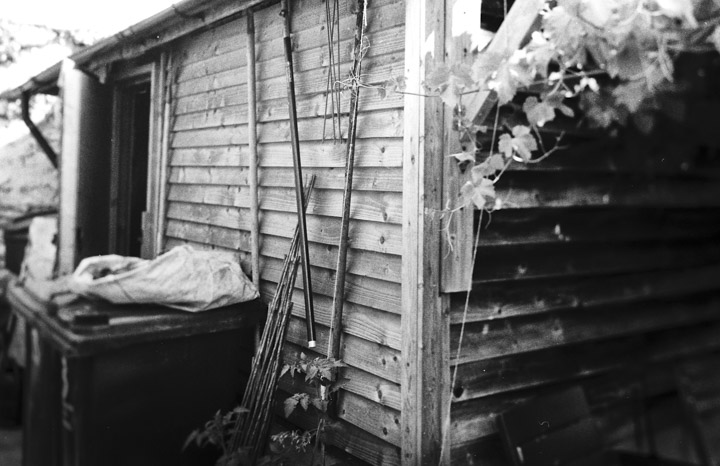
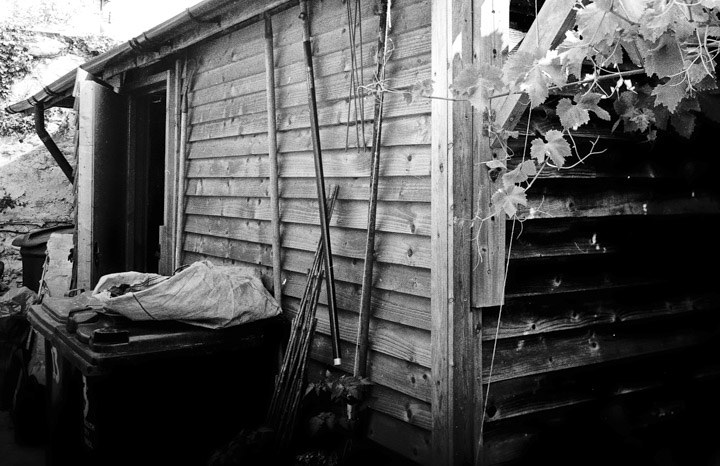
I took four pairs of photographs to give some idea of how it works. Each photograph represents a specific problem that will relate to depth of field, foreground or back ground. You can solve some depth of field problems by reducing the lens aperture, but that can mean keeping elements that are not wanted in the finished image, such as background, or some level of sharpness in a close-up. In all of the photographs taken, I used an aperture of f2.8 or f4. As you scroll down the first photograph is taken with the lens in a standard position, the second photograph is taken when the lens has been adjusted vertically and/or horizontally.
Stanley Plane: The problem here is that the angle of the plane, relative to the closeness of the lens means that the greater part of the plane will be out of focus at apertures wide enough to keep the background out of focus. The solution, is to use swing to bring a larger area of the image into focus at wide apertures without giving prominence to the background. The image using swing is not perfect, but it is better than it was without the swing function.


Pegs: The standard 35mm image of the basket of pegs means that for the pegs in the basket to be relatively sharp, the background is too sharp and the two pegs to the rear of the basket are out of focus. In this case, I have set the lens orientation to vertical and used tilt bringing the rear pegs into better focus along with some of the pegs in the basket and throwing the background out of focus.


Spot Meter: This was tricky and not perfectly solved, but the extreme out of focus EV dial puts all the emphasis on the lens cap rather than the meter as a whole. Again, in vertical orientation, I can use Tilt to bring it closer to something recognisable, even if it is not perfect and more of the spot meter itself is in focus. Note, Tilt has changed the photograph’s frame which is simple enough to change using your tripod head.


Garden Shed: The problem here is to bring the front and the back of the shed into better focus and cure a slight converging vertical. Tilt would solve any the issue of converging verticals, but not left to right sharpness. Conversely, Swing would help to solve the left to right depth of field, but not convergence. The solution, in this case is to orientate to lens at 45 degrees to vertical, giving some swing and tilt in unison.
Obviously, using a view camera gives you access to all of these movements, but if you are a 35mm shooter, then a tilt/shift lens gives you the opportunity to use some movement that approximates those of large format monorails in a controlled way. Tilt/swing controls have a knurled screw that can be locked into place and degrees of movement are marked off on the lens body. Similarly, rise/fall and shift is controlled by a separate screw.
Undoubtedly a tilt/shift lens is invaluable if you want to shoot architecture giving you controls and solutions to issues that would otherwise have to be fixed in post and I think they are great for studio and still life work giving you a lot of perspective control allowing you to choose where you want your main focus point to be and what you want to throw out of focus. A specialist lens, of course, but one you might want to consider and use to good effect.
Click to see our current selection of Canon lenses


